Machine Learning
What is it?
Machine Learning auto-approval is a feature of Admin By Request (ABR) that automatically builds a list of trusted applications over time by watching which elevation requests get manually approved - and then auto-approving those applications on all future requests once they have accumulated enough approvals.
Rather than requiring administrators to build a pre-approval allow-list upfront (which demands detailed prior knowledge of what software their users actually run), Machine Learning lets that list grow organically as the normal approval workflow operates. The administrator sets a threshold - a count of how many manual approvals are required before an application is considered trusted - and once any given application reaches that threshold, all subsequent elevation requests for it are handled automatically without any portal notification or human decision.
Machine Learning is available on Windows and macOS, and needs the Require Approval setting to be active.
What problem does it solve?
When an organization first deploys ABR and enables the approval workflow, administrators start receiving elevation requests for everything - including software that is completely routine and predictable: the corporate VPN client, the IT department's standard toolchain, third-party drivers that the facilities team installs every week. Every one of those requests requires a human to open the portal, read the request, and click Approve. None of that requires any genuine judgment, but all of it consumes time and attention.
The traditional answer is to build a Pre-Approval list upfront: identify all the software that users need elevated, add it to the allow-list, and save approvers from ever seeing those requests. The problem is that building this list requires detailed prior knowledge of what users actually run. In practice, most organizations do not have that inventory when they first deploy ABR. Compiling it from scratch is slow and error-prone. For a large enterprise with tens of thousands of employees, the list might run to thousands of distinct applications across departments, versions, and user groups. No one person knows all of it in advance.
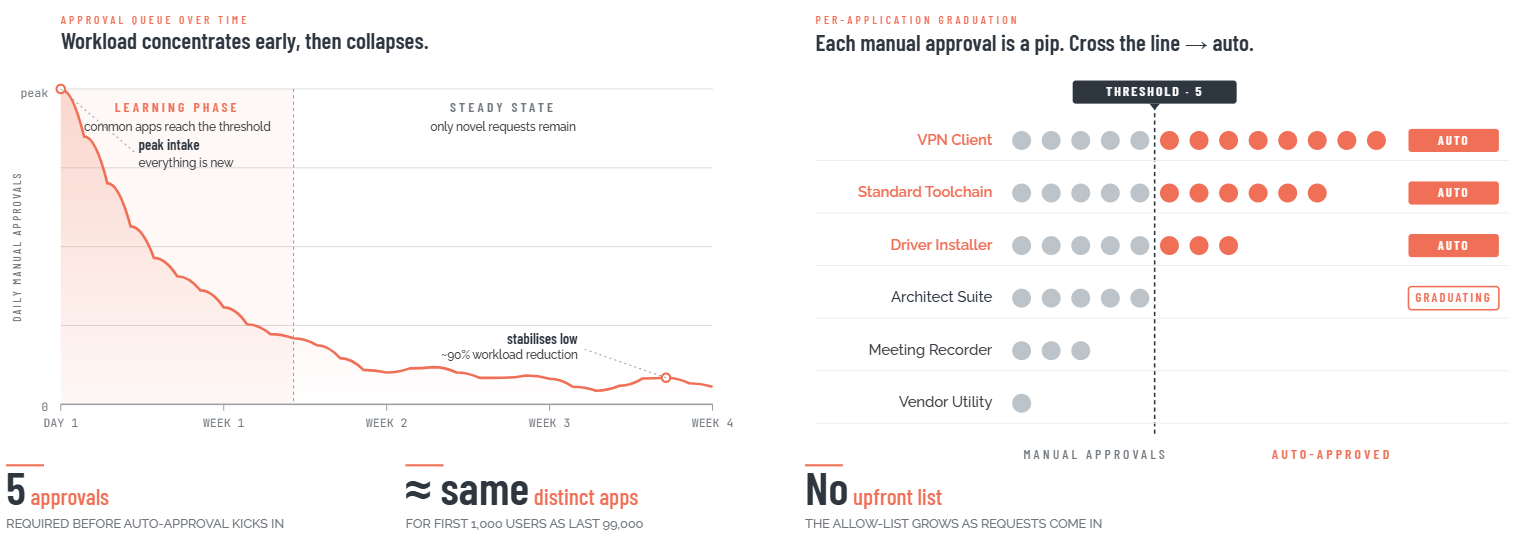
ABR's own research, drawing on data from thousands of customers, found that a company of 100,000 employees will likely receive roughly the same number of distinct elevation requests for its first 1,000 users as for its last 99,000 - because users across a large organization tend to elevate the same core set of applications. This means the approval workload concentrates in the early rollout phase, and then rapidly declines as the same applications are re-requested.
Machine Learning takes advantage of this pattern. Instead of requiring administrators to predict what software needs elevation, it watches what actually gets approved over time and promotes frequently approved applications to automatic status on its own. In other words, the pre-approval list builds itself as the approval workflow runs. The workload reduction accumulates automatically.
This is particularly valuable during initial rollout. An organization transitioning from standing local admin rights often cannot enumerate all elevated software in advance. With Machine Learning enabled, they can begin enforcing the approval workflow immediately. The first approvals for each application are manual. Once any given application has been approved the configured number of times, it graduates to the Machine Learning auto-approval list and never needs manual approval again.
The practical result: in a typical deployment, the approval queue is busiest in the first few days, shrinks rapidly over the first week or two as the most common applications are learned in, and then stabilizes at a much lower volume consisting only of genuinely novel or unusual requests.
The allow-list builds itself
Watch what gets manually approved. After N approvals, an app graduates - every request after that is automatic.